Rain on the roof
- Andy Fitz-Gibbon
- May 10
- 4 min read

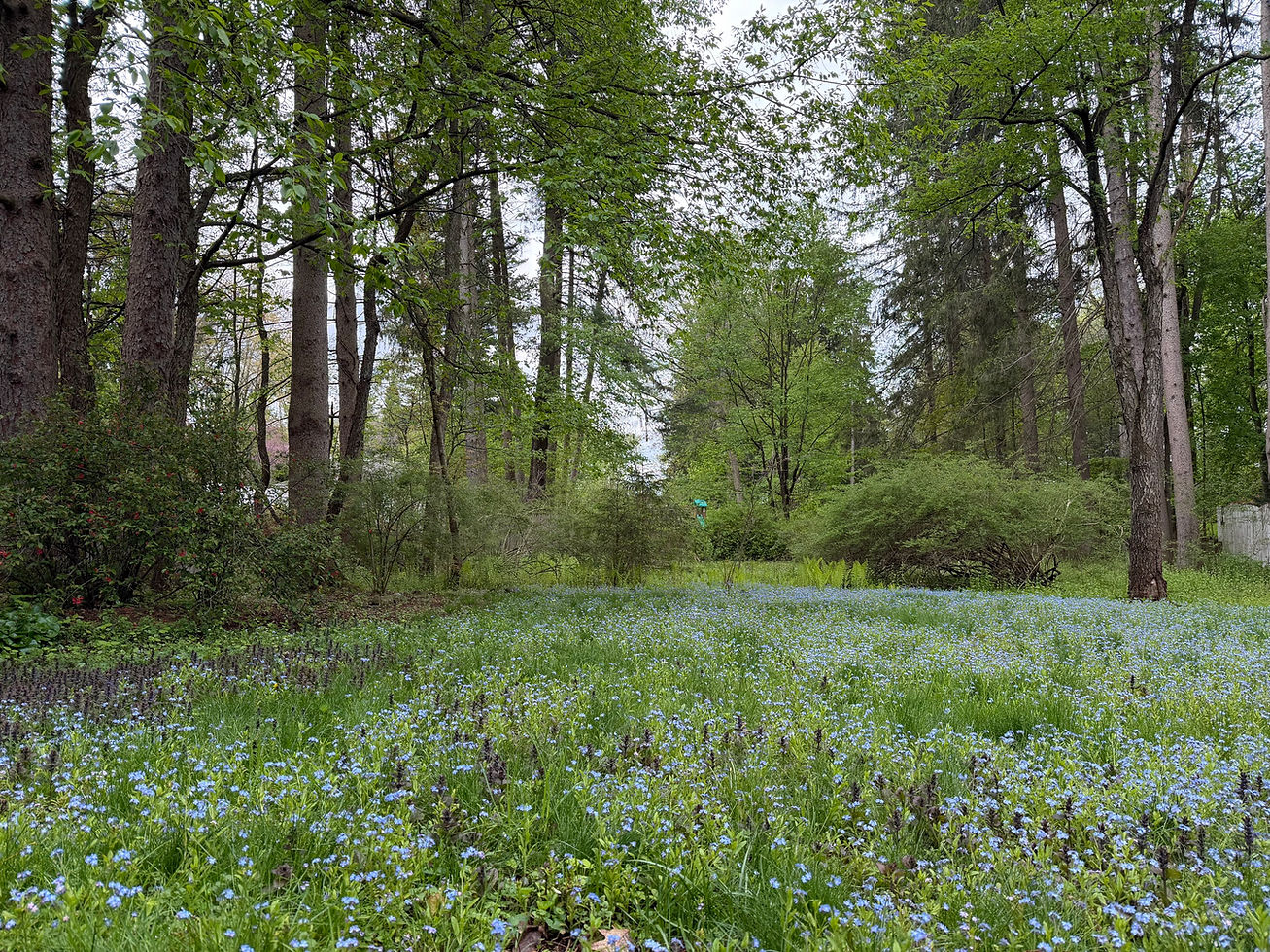
One day this past week, as I sat with a cup of tea in my morning meditation, I became aware of steady and unhurried rain on the kitchen roof. I watched the yard through the patio doors, taking in the scene. The grass had turned that deep May green. The trees were coming toward their fullness. The sky was dark where, on another day, it would be bright. The whole scene had a density to it, as if nature had drawn closer to our home.
Recently, I have found myself returning, in a more deliberate way, to my connection with nature. It has not just been an idea, and not a topic for reflection alone, but as something that has pressed into ordinary experience. The sound of rain, the weight of the air, the way the landscape holds together as a whole rather than as a set of separate objects. It is difficult to describe but has become something about attention.
When we came to the United States, I discovered the American Transcendentalists (Emerson Thoreau, Whitman). I had not grown up with them, as in England, they had never crossed my path. Since then, I have dipped in and out without ever making them central, seeing them out of the corner of my eye, as it were. It struck me on that recent morning that the view from my kitchen is not so far removed from what Thoreau would have seen at Walden Pond. Ithaca New York offers a similar kind of landscape to Concord Massachusetts. Those formative thinkers believed that human beings could encounter truth directly through intuition, conscience, imagination, and deep engagement with nature. They emphasized individual experience over institutional authority. Nature was not merely scenery or raw material. It was alive with meaning and moral significance. Thankfully, that is becoming my experience.
Years ago, when we wandered in the English Lake District when our children were young, I felt something similar without really naming it. The landscape there is different in scale and shape, but it carries the same sense of presence. It is easy to see why William Wordsworth found in it a source of reflection that went beyond description, though his descriptions are evocative. For fun, I ferreted out a tiny anthology of his poetry we bought on a trip to Dove Cottage on Grassmere where Wordsworth lived for a few years. I spent a happy half hour in his company. The Romantic movement, of which Wordsworth was a significant figure, was also a way of refusing to reduce the world to what can be measured and explained.
Much of modern thought, especially in its more reductive forms, treats nature as if it were exhausted by physical description. We have precise language, and helpful scientific explanations. But something is lost when the world is approached only in this way. The experience of being in nature, the sense of depth, the emergence of value, the felt presence of beauty, of the divine, of the sacred—these are not captured by scientific analysis.
So I find myself in closer alignment with both the English Romantics and the American Transcendentalists, though not without qualification. What I share with them is a renewed sense of wonder—not as a vague sentiment, but as a particular feel, the moment when the ordinary is no longer “ordinary,” and rain is not just precipitation, and the trees are not just biological structures. Nature has invited my attention.
There is a discipline in this. To notice requires time and a willingness to set aside, at least temporarily, the constant movement toward explanation. Explanation has its place. It is essential in many contexts. But it is not the only way of engaging with the world. Here I am reminded of Iris Murdoch and her account of attention as a moral practice. To attend properly is not simply to look, but to look carefully and without distortion—to resist the pull of self-centered interpretation and to allow what is there to show itself. This kind of attention is not passive. It requires effort and is trained, habituated even. In this sense, the act of noticing the rain, the trees, the particular quality of the morning, is not trivial. It is a small exercise in seeing more clearly.
But I am less inclined to follow the Transcendentalists into a more overt idealism. Their language sometimes suggests that mind or spirit stands behind or above the natural world. My own developing view is more grounded. Nature is primary. Mind, value, and meaning arise within it and not apart from it. Here is something I am exploring: I do not feel the need to move beyond nature in order to account for what is experienced. There is no need to posit a separate realm or a supernatural order. Nature, understood in a non-reductive way, is sufficient. It includes not only what is physical, but also what is lived: love, goodness, truth, beauty, consciousness, relationality, value, and meaning. As nature draws my attention, G*d is found as an aspect of the whole, not something set apart from it.
I draw no conclusion from this other than to attend, to reflect, and to remain open to the depth of what is already present.
+Ab. Andy


Comments